
ID4Africa 2025 – Navigating opportunities across the continent

ID4Africa 2025 – Navigating opportunities across the continent

Author: Veronica von Preysing, Eviden Digital Identity
ID4Africa has always been a unique fixture on our events calendar — each year in a new African host country, each year a fresh adventure. This time, the journey took us to Addis Ababa, Ethiopia, from 20–22 May 2025. And while the ever-changing local exhibition realities bring a dash of unpredictability (and the occasional touch of chaos), they’re part of what makes this event so dynamic — and so important.

Our presence in Addis was a testament to the deep relationships we’ve built with partners and customers across the African continent. We met with the National Identity Management Commission (Nigeria), Margins ID Group (Ghana), and technology leaders like ST Microelectronics, Infineon, and Neurotechnology. Longstanding partners Veridos, Mühlbauer ID Services, and Toppan Security were also on the agenda, alongside productive discussions with new and existing contacts from across the ID ecosystem.

These exchanges touched on critical topics: upgrading national PKI infrastructures, supporting new eID rollouts, launching advanced chip platforms, and extending our reach into emerging opportunities in countries such as Gambia and the Democratic Republic of Congo. Many of these programs have the potential to impact millions, underlining the trust our partners place in our expertise.

From bustling exhibition halls to more focused side meetings, the energy was palpable. ID4Africa 2025 reaffirmed why, despite its unpredictability, this is one of our most strategic events of the year: it’s where relationships are deepened, opportunities emerge, and the future of identity in Africa takes shape — one conversation at a time.

Next year’s adventure will take us to the Republic of Côte d’Ivoire, a fascinating destination that offers a blend of culture, cuisine, music, wildlife, and natural beauty, and no doubt another major milestone for our customers and partners.

ID4Africa: It was a great pleasure to meet NIMC’s new DG, Engr. Abisoye Coker-Odusote and her team at ID4Africa in Addis Ababa
Canals, connections, and conversations: Eviden at Identity Week 2025

Canals, connections, and conversations: Eviden at Identity Week 2025

Author: Veronica von Preysing, Eviden Digital Identity
Amsterdam was buzzing on June 17–18 as the identity industry gathered for Identity Week 2025 — and Eviden Digital ID was right in the mix. The event brought together an impressive collection of experts, innovators, and partners from across the globe, making it a prime spot for networking, fresh ideas, and a good dose of industry gossip.

Over the two days, our team caught up with key industry players including Infineon, G.E.T. Group, Veridos, Mühlbauer ID Services, AdvanIDe, Austria Card, SELP, Horizon Ltd., E7, and Laxton. From discussing future collaborations to exploring current project updates, the conversations were productive and full of potential.

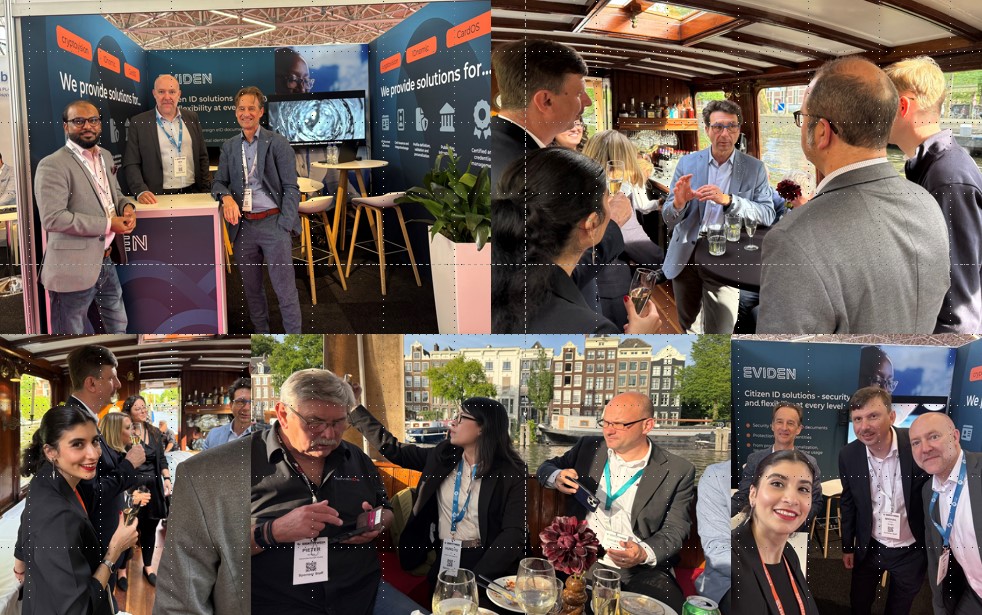
While the conference floor was lively, the highlight for many came off-site — our very own customer event aboard a boat on Amsterdam’s scenic canals. Between the historic bridges and city lights, conversations flowed just as easily as the refreshments. The relaxed atmosphere gave everyone the chance to connect on a personal level, spark ideas for future partnerships, and, of course, enjoy a bit of Dutch summer charm.

Identity Week 2025 proved to be a valuable mix of business and enjoyment — a reminder that in this sector, the best results often come from strong relationships built over shared moments, whether in a meeting room or while cruising along the water. It’s safe to say we sailed away with new opportunities and fresh momentum for the year ahead.

Mindshare 2025 – a cybersecurity event that set the bar high

Mindshare 2025 – a cybersecurity event that set the bar high

From September 10–11, 2025, Gelsenkirchen once again transformed into a hub for the global digital identity and cybersecurity community. Mindshare 2025, hosted by Eviden Digital Identity, proved to be more than a conference — it was a two-day deep dive into the technologies, policies, and partnerships shaping the future of secure digital identity.

Now in its latest edition, Mindshare lived up to its reputation as a uniquely vibrant mix of high-calibre talks, cutting-edge exhibition showcases, and unmatched networking opportunities. And this year’s agenda set a new benchmark.

The big topics – from quantum threats to digital wallets

Post-Quantum Cryptography (PQC) took center stage in 2025. Across seven dedicated presentations, leading experts tackled PQC migration strategies, the latest in global standardisation efforts, and practical use cases for smart cards and eID documents. Speakers like Kim Nguyen (Bundesdruckerei) and Lea Nagler (BSI) shared real-world insights into preparing for a post-quantum world — a topic both urgent and unavoidable.

The program also looked beyond the purely technical. Highlights included Roland Adrian (Verimi) on the coming rollout of European EUDI wallets, Arno Fiedler (Nimbus) on eIDAS 2024’s impact on sovereignty, and Klaus Schmeh on the growing security threat of deepfakes. For a lighter take with sharp insights, “comedy hacker” Tobias Schrödel once again entertained while exposing the murky conversations between cybercriminals.

The exhibition – where innovation met hands-on experience

Mindshare’s compact exhibition space brought together leading names in the industry — including Mühlbauer, Infineon and Eviden’s Cyber Products — giving visitors a rare opportunity to connect directly with the people designing the technologies that protect billions of identities worldwide.

Networking – the legendary CryptoNite party

As always, the CryptoNite Party delivered. This now-legendary evening once again proved to be the place where the real connections were forged — with policymakers, engineers, entrepreneurs, and innovators all in the same room, talking shop long after the sessions had ended.

Why it mattered

Mindshare 2025 confirmed its role as a must-attend event for anyone serious about the future of secure identity — from government decision-makers to tech entrepreneurs, security architects to academic researchers. It was where technical expertise met strategic thinking, and where the most important conversations in digital trust took place.

Klaus Comments: Invest in PQC now or wait?

Klaus Comments: Invest in PQC now or wait?

IN THIS COLUMN, EVIDEN’S CRYPTOEXPERT

KLAUS SCHMEH COMMENTS ON CRYPTO STUFF

Everyone in the security community is talking about post-quantum cryptography (PQC) and the so-called Q-Day—the day when quantum computers become powerful enough to break some of today’s widely used cryptographic algorithms. Even Der Spiegel, one of Germany’s most influential news magazines, has recently covered the topic extensively with a headline as dramatic as: “The day when the world’s security collapses.”

So, should only cryptographers, standardization bodies, and protocol developers worry about PQC? Or must enterprises and public authorities also act today? Some argue it is still too early because:

  • Q-Day is likely years, perhaps even decades away.
  • The PQC standardization process is still ongoing.
  • There are only a handful of PQC-enabled products on the market. In most cases, PQC support is still in the testing phase.
  • And not every candidate algorithm has yet proven secure.

At first glance, this sounds reasonable. But experts warn against complacency. Their message is clear:start preparing now. Why the urgency?

  • Migration is complex and time-consuming. Replacing cryptographic foundations across IT infrastructures cannot be done overnight.
  • “Store now, decrypt later.” Sensitive data encrypted today may still be valuable when Q-Day arrives. Adversaries could be harvesting information already.
  • Regulators are moving. Authorities such as Germany’s BSI and France’s ANSSI are drafting guidelines that will require critical systems to be quantum-resistant within the next decade.
  • Talent shortages. Expertise in PQC is scarce, and the longer organizations wait, the harder it will be to secure skilled professionals.

The good news: the first steps in a PQC migration do not require finalized standards or market-ready products. Inventory and risk assessment can and should be started today. Organizations need to identify where cryptography is used, assess risks, and raise awareness among decision-makers, administrators, and end users. And, of course, it makes sense to start looking now at products that already support PQC—such as cryptovision GreenShield. This groundwork will pay off once the transition accelerates.
Conclusion: While it may be premature in most cases to deploy PQC right now, it is absolutely prudent to begin inventory and risk assessment today. Those who start early will not only reduce future risks but also ensure a smoother migration path. Eviden Digital Identity is ready to support you on this journey.

Unsolved encryption mysteries: The mysterious newspaper ad from Colorado

Unsolved encryption mysteries: The mysterious newspaper ad from Colorado

Author: Klaus Schmeh, Eviden Digital Identity

This column is dedicated to unraveling unsolved encryption puzzles. Each month, we will present a different encrypted message that has thus far resisted all attempts at decryption. Today, we introduce : an encrypted newspaper ad published in 1889.

Encrypted Newspaper Ads

In the late 19th century, newspapers weren’t just a booming mass medium—they also became a platform for secret communication. Encrypted newspaper ads were a popular way to send hidden messages, meant only for the eyes of a specific recipient.
Most of these encrypted messages came from lovers, who used the anonymity of newspaper classifieds to exchange romantic notes in plain sight. But it wasn’t just matters of the heart. Businesspeople, detectives, scientists, and travelers also made use of encrypted ads to communicate confidentially across great distances.

To date, around 5,000 encrypted newspaper ads from the 19th century have been cataloged, though researchers believe the real number is much higher. Many of these messages are relatively easy to decipher today with modern tools. Still, hundreds remain unsolved—puzzling cryptographers, historians, and enthusiasts alike.

Despite many attempts over the years, no one has yet succeeded in cracking the code of this newspaper ad.

 The mysterious ad from Gun Wa

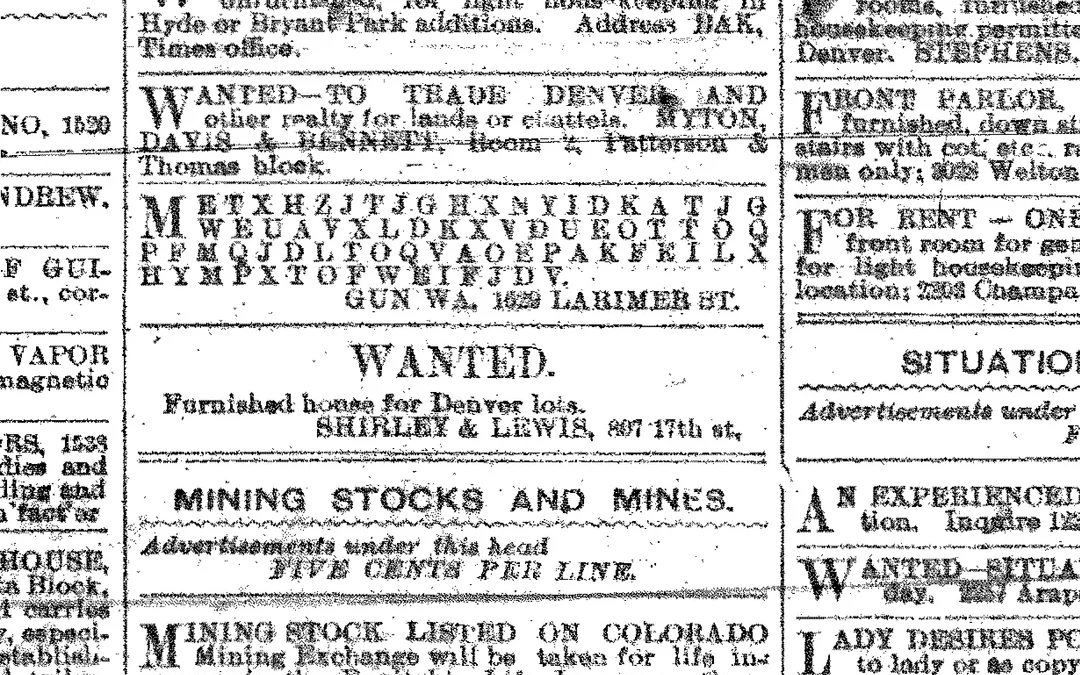
One of the most puzzling encrypted newspaper ads appeared on July 23, 1889, in the Denver Times, a newspaper based in Denver, Colorado. Unlike many anonymous or coded messages, this ad clearly stated the name and address of its publisher: a company called Gun Wa.

METXHZJTJGHXNYIDKATJG
WEUAVXLDKXVDUEOTTOQ
PFMQJDLTOQVAOEPAKFEILX
HYMPXTOFWEIFJDV
GUN WA. 1629 LARIMER ST.

Gun Wa was a business operated by a group of American entrepreneurs marketing questionable medicinal products under the name of a fictional Chinese doctor—“Dr. Gun Wa.” The company placed numerous (unencrypted) advertisements in newspapers across the United States, promoting these so-called remedies with bold promises and exotic flair.

But the encrypted ad in the Denver Times stands out. As far as we know, it is the only instance in which the company used an enciphered message—raising many questions. Was it a private message disguised as a public notice? A marketing stunt? Or something more clandestine? We don’t know.
The encryption method used in the ad remains unknown. However, it is believed to have been quite sophisticated for its time—otherwise, it would likely have been solved by now.

Can you help?

Despite many attempts over the years, no one has yet succeeded in cracking the code of this advertisement. If you think you can help solve this puzzle, or if you have any thoughts on what might be behind this cryptic message, please get in touch.